Turkey Teeth and the Label Trick: Is That Straumann Really a Straumann?
The cheapest Turkey teeth packages advertise premium implant brands at prices the genuine components alone should not allow. The trick lives in the labelling. Here is how the substitution works, and the paperwork that proves what actually went into your jaw.
Key Takeaways
The cheapest Turkey teeth packages resolve an impossible sum, premium brand names sitting above prices that undercut the genuine components, and the resolution usually happens in the labelling: an economy system such as Osstem or Neodent placed under a "Straumann" headline, or a Straumann Group value brand conflated with Straumann itself. The defence is paperwork, not suspicion. Every genuine branded implant ships in sealed sterile packaging with peel-off labels stating the manufacturer, the catalogue (REF) number and the LOT number, and a legitimate clinic anywhere fixes one into your record, gives you a copy, and issues an implant passport naming the brand, model, size and position of every fixture. Get the exact model in writing before you pay, see the sealed packaging before surgery, take the labels home, and the headline price stops being the story.
- A genuine Straumann or Nobel Biocare fixture costs a clinic several times what an economy system does. When an all-inclusive Turkey package undercuts what the branded components alone should cost, the arithmetic gets resolved somewhere you cannot see, and the labelling is where.
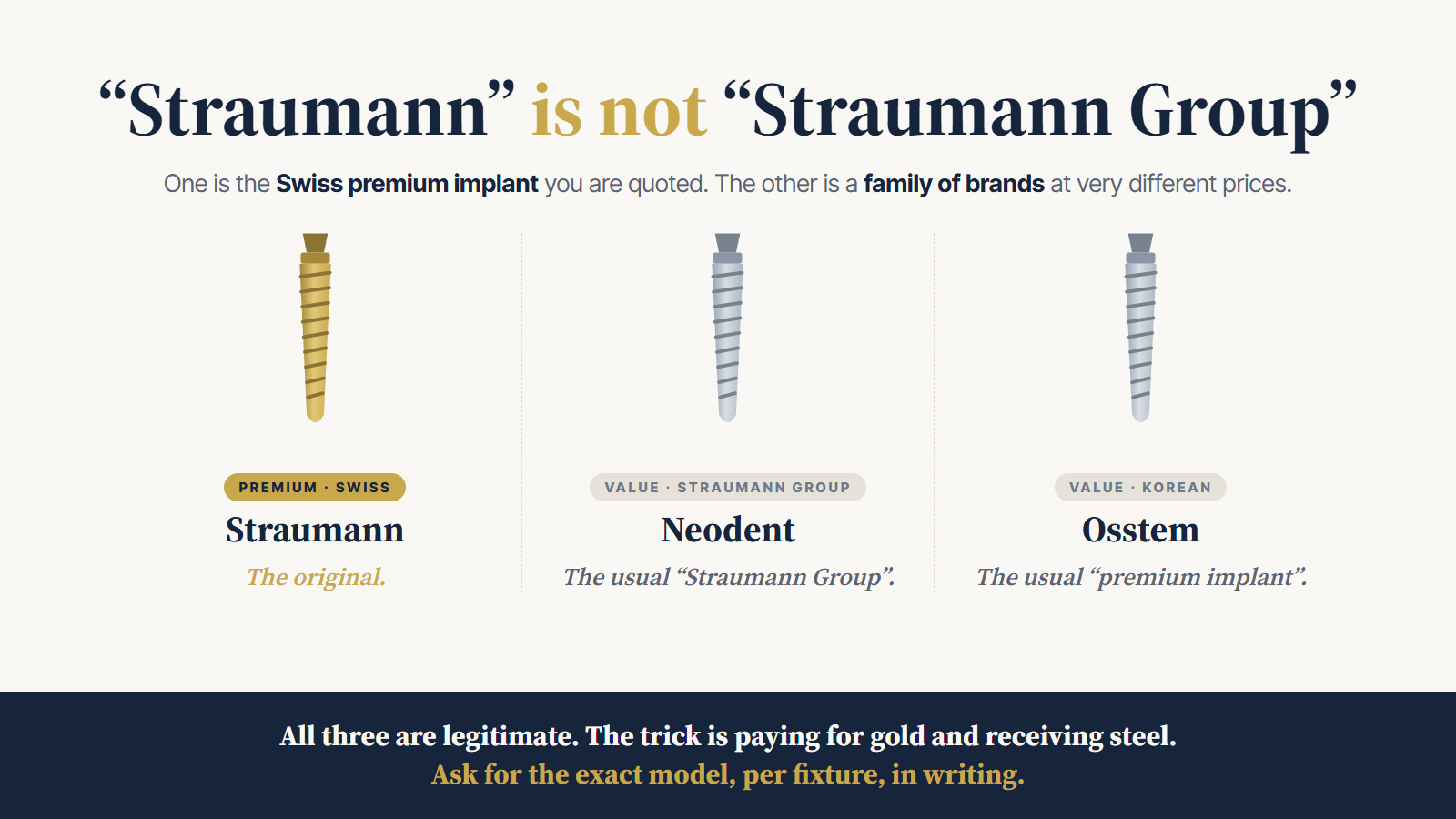
- The commonest version is not counterfeiting. It is conflation: Neodent is a value brand owned by the Straumann Group, and "a Straumann Group implant" is not a Straumann. The word on the invoice that matters is the model, not the family.
- Every genuine branded implant ships in sealed sterile packaging with peel-off labels: manufacturer, catalogue reference, LOT number. Those labels belong in your clinical record and in your hand.
- An implant passport records the brand, model, diameter, length and position of every fixture placed. Any future dentist needs it for crowns, repairs or revision, so asking for it is normal, not rude.
- This model is invulnerable to price attacks, the cheap headline is its whole strength, and defenceless against transparency. Once the brand and model are named in writing, per fixture, the comparison becomes honest, and honest comparisons are the one thing the trick cannot survive.
Honest risk note
Where the label trick lives
It concentrates where packages are cheapest and volume is highest, which for UK patients today means the discount end of the Turkey teeth market. Not every Turkish clinic plays it, the good ones name their systems in writing like good clinics anywhere. But the pattern is documented enough that UK dental bodies have flagged the wave of returning corrective cases, and the arithmetic of the cheapest packages does not add up any other way. Wherever you go, whoever you book with, the paperwork in this article is how you make the headline tell the truth.
The impossible arithmetic behind the cheapest packages
Start with a sum anyone can do.
Where the arithmetic gets resolved
The resolution happens in the labelling, and an implant is the perfect place to hide it: the fixture disappears into bone on the day it is placed, and to most patients one titanium screw looks exactly like another. UK dental bodies have flagged the wave of returning corrective cases from exactly this end of the market, and the British Dental Association has reported the overwhelming majority of its surveyed members treating patients who needed work redone after treatment abroad. The failures concentrate where the packages are cheapest, because that is where the arithmetic is under the most pressure.
You will rarely meet an outright lie. You will meet "premium implant", "Swiss implant", "same quality as Straumann", and the most elegant version of all, described next, a truthful-sounding sentence engineered so that nobody is technically lying and nobody is accountable either. None of it requires dishonest dentists, and Turkey has many excellent ones who name their systems in writing like anyone else. It requires only the absence of paperwork, and paperwork is precisely what the sales chat never volunteers.
The Neodent sentence: how "Straumann" gets said without being lied
The blunt version of the trick is simply saying "we use Straumann implants" and placing something else. That is misrepresentation, plain and cheap, and it happens. But the sharper version runs on a true fact. Neodent is a respected Brazilian value brand, and it is owned by the Straumann Group. So a package can place a Neodent fixture, tell you "we use Straumann Group implants", and every word survives a lawyer. What does not survive is your assumption: a Neodent fixture is a different product, at a different price tier, with different components, from the Straumann implant whose reputation you were buying, and the price difference between them is a meaningful part of how the impossible package total gets resolved.
Osstem plays a similar role without the family connection: a legitimate, widely-placed Korean value system that appears in packages under phrases like "premium implant" or "top implant brand". To be plain, because fairness is the point of this article: Neodent and Osstem are not bad implants. Offered openly, by name, at their honest price, they are reasonable choices that good clinics in every country sell every day. The trick is never the product. The trick is the gap between the brand you believed and the brand you received, and that gap is worth hundreds of pounds per fixture to whoever does not mention it.
The vaccine is a single written sentence: the exact system and model, per fixture, in the quote, before any money moves. "Straumann BLT, one fixture, site 36" cannot be conflated with anything. A clinic that will happily say "Straumann" across a sales chat but will not write the model into the quote has told you everything, in the politest possible way.
The paperwork that exists for exactly this moment
Implant manufacturers solved the traceability problem years ago, because future dentists need to know precisely what is in a patient's jaw before they can work on it. Three documents do the job.
The five moments to verify, from quote to years later
What the LOT number actually unlocks
The LOT number is the difference between a brand claim and a brand fact. With it, the manufacturer can confirm the fixture is genuine, when and where that batch was produced, and that it corresponds to the catalogue reference on your paperwork. Without it, nobody, including the most sympathetic dentist at home, can prove what is in the bone short of removing it.
It also carries practical consequences that surface years later. Implant systems are proprietary ecosystems: abutments, screws and repair components fit their own system and nothing else, so the dentist replacing your crown in a decade needs the exact model, not the general idea. Manufacturer warranty programmes honour genuine, documented components, and a warranty claim without paperwork is a conversation that ends quickly. And in the rare event of a batch recall or advisory, the LOT number is the only way anyone can tell whether it concerns you.
One honest caveat belongs here: a documented non-premium implant is a better clinical position than an undocumented premium one. Established value systems, widely placed and well studied, are legitimate choices that many excellent clinics offer openly at lower prices. The failure mode this article exists for is not the affordable implant. It is paying for one thing and receiving another, or receiving anything at all without the trail that future dentistry depends on.
Red flags that the invoice brand may not be the jaw brand
How a coordinated trip closes this gap
On a DentAItinerary trip, brand verification is not left to the patient's assertiveness on the day. The implant system is named in the fixed written quote before you travel, per fixture, and that quote is the contract. The chair-side labels and the implant passport are a required part of the records handover our coordinator collects before you fly home, alongside your radiographs, so the paper trail exists whether or not you remembered to ask for it while numb.
And if the planned system genuinely cannot be used on the day, a stock issue, an intra-operative finding that changes the fixture specification, that is not a chair-side substitution. It is a deviation, and it runs through the Deviation Protocol: documented in writing, priced from the pre-agreed menu where relevant, and proceeding only with your written approval. The clinical judgement stays with the treating clinicians, where it belongs. What is removed is the possibility of the invoice and the jaw quietly disagreeing.
Whether you travel with us or with nobody, take this article's checklist with you. The clinics worth your jaw will pass it without noticing they were being tested.
Key terms
- Implant passport
- A patient-held record, paper or digital, listing the brand, model, diameter, length and jaw position of each implant placed, with treatment dates and the treating clinician. Any future dentist needs it before working on the implants.
- LOT number
- The manufacturer's batch identifier printed on the sterile packaging of a genuine implant. It lets the manufacturer confirm the fixture is genuine and traceable, and it is the anchor for warranty and recall questions.
- REF (catalogue number)
- The manufacturer's catalogue reference identifying the exact implant model and dimensions. Combined with the LOT number, it specifies precisely which product entered your jaw.
- UDI
- Unique Device Identification, the standardised code carried on medical device packaging that makes an individual device traceable through regulatory databases.
- Straumann vs Straumann Group
- Straumann is the premium Swiss implant brand. The Straumann Group is the parent company that also owns value brands including Neodent. "A Straumann Group implant" can therefore describe a much cheaper product than a Straumann. The model name on your quote and labels is what settles it.
Common mistakes to avoid
- 1
Accepting "premium implant" as if it were a brand
Premium is an adjective, not a manufacturer. If the quote does not name the system per fixture, the system has not been promised, whatever was said in the consultation.
- 2
Flying home without the labels
The peel-off labels exist on the day of surgery or never. Once you are home, a clinic that did not volunteer them rarely produces them, and your future dentist inherits a guessing game.
- 3
Judging authenticity by price alone, in either direction
A high price does not prove a genuine premium fixture, and an honest value system is not a scandal. Paperwork proves what price only implies. Verify the documents, not the invoice total.
Questions to ask the clinic
Bring these to your first consultation. Ask in writing where possible.
Ask any clinic, anywhere, before you book
- Which implant system, by brand and model, is in my written quote, per fixture?
- May I see the sealed packaging before placement?
- Will the packaging label go into my clinical record, and may I have a copy the same day?
- Will I receive an implant passport with my records before I fly home?
- Are the components you place registered for the manufacturer's warranty programme?
Frequently asked questions
Can an X-ray identify which implant brand I have?
+
Largely, yes. Implant systems have distinctive radiographic signatures in their thread pattern, taper and connection geometry, and an experienced implantologist can often identify or shortlist the system from a clear OPG or CBCT. It is the backstop, not the plan: an implant passport and the packaging labels answer in seconds what a radiograph answers in a referral.
Is a non-premium implant always a bad implant?
+
No. Established value systems like Osstem and Neodent are widely placed, well studied and offered openly by excellent clinics at honest prices. The failure mode is substitution, paying for one system and receiving another, or receiving any system at all without documentation. A documented value implant is a better clinical position than an undocumented premium one.
Is Neodent the same as Straumann?
+
No, and the difference is where the commonest version of the label trick lives. Neodent is a value brand owned by the Straumann Group, a legitimate product at a much lower component price than a Straumann implant. "Straumann Group" in a sales chat is not a promise of a Straumann fixture. Ask for the exact model, per fixture, in writing, and the ambiguity disappears.
My treatment already happened and I have no paperwork. What now?
+
Request your clinical records from the treating clinic in writing, asking specifically for the implant system name, REF and LOT numbers from your notes. In parallel, any implantologist can assess your radiographs against the claimed system, and the manufacturer can confirm whether a LOT number you are given is genuine. Do this before any new crown or component work, because your next dentist will need the answer anyway.
Do genuine clinics mind being asked to prove the brand?
+
No. Implant passports and label documentation are standard practice wherever genuine components are placed, and professional teams hand them over as routine. A clinic that bristles at a thirty-second show of sealed packaging is answering the question, just not in the way it intended.
Does DentAItinerary name the implant brand before I pay?
+
Yes. The implant system is named per fixture in the fixed written quote before you travel, the chair-side labels and implant passport are a required part of your records handover, and any genuine on-the-day change to the planned system runs through the Deviation Protocol in writing. The invoice and the jaw are never allowed to disagree quietly.
About this guide
Written by: DentAItinerary Editorial Team
Reviewed by: DentAItinerary editorial review (see Editorial Policy)
Published: 30 Aug 2026 · Last reviewed:
We follow the DentAItinerary Editorial Policy: every health-related claim is sourced, indicative pricing is clearly labelled, and we do not provide medical advice. See our medical disclaimer.
Get notified of new guides
No spam. One email per new post. Unsubscribe anytime.
Prefer RSS? Subscribe via RSS feed
Ready to see what your trip could cost?
Build a free indicative itinerary in 60 seconds. No sign-up required.
Was this article helpful?
Sources
- General Dental Council: going abroad for dental treatment
- NHS: Going abroad for treatment, treatment-abroad checklist
- Zimmer Biomet: Patient information about implantable medical devices
- DentSpa: What is a dental implant passport?
DentAItinerary provides planning information and coordination support, not dental diagnosis or medical advice. Final clinical decisions are made by the treating dental clinic.