No Scan, No Quote: The X-Ray Rule for Dental Implants Abroad
A price from photos is a starting point, not a final one. What an OPG shows, when a CBCT scan is needed, what each costs in the UK, and why no implant plan should be final, or begin, until a scan has been read.
Key Takeaways
A clinic can give you a tentative price for dental implants from clear photos, and an honest one will call it tentative. What no clinic should do is finalise your plan, or start any work, without a scan. A panoramic X-ray, called an OPG, supports a written plan with contingencies priced. A CBCT scan confirms the surgical plan before anything is drilled. The scan can be done at home before you fly or on your first morning at the clinic. If a clinic treats a photo price as final, or offers a discount for committing today, that number is marketing, not a treatment plan.
- A price given without imaging cannot account for bone volume, sinus position or which of your teeth are genuinely savable. It is a tentative price, and an honest clinic calls it that.
- An OPG (panoramic X-ray) typically costs £30 to £120 self-pay at UK private practices and is enough for a specialist to build a provisional plan and a fixed written quote.
- A CBCT scan is the clinical standard before implant surgery. Established Indian clinics take one in-house before any work begins, usually for under £50 against £150 to £400 in the UK.
- Sign-today discounts and unscanned quotes travel together. A price anchored to your anatomy does not fall because you commit in the room.
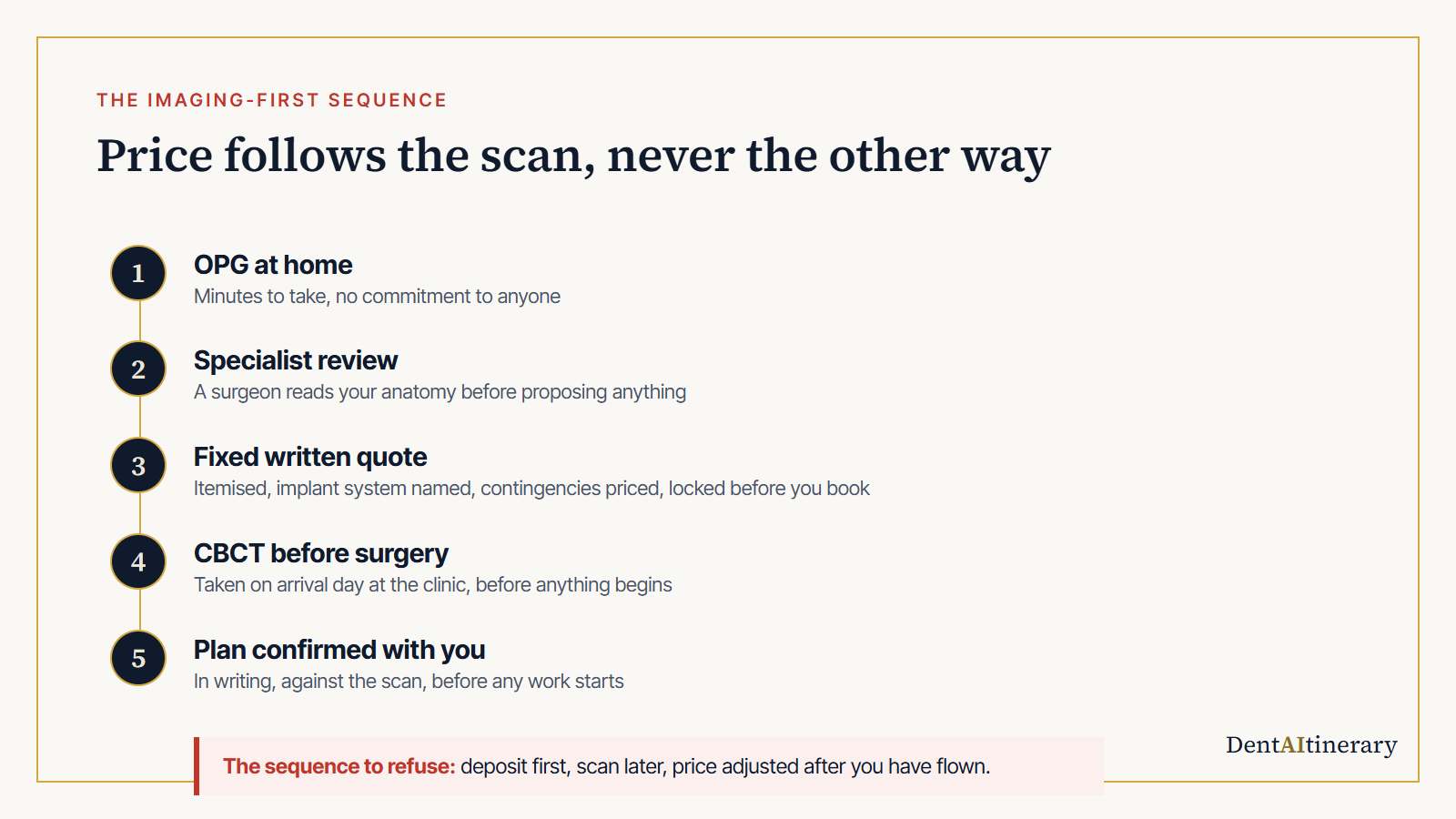
- The safe sequence: tentative price from photos, a scan at home or on arrival, fixed written quote with contingencies priced, final plan confirmed with you before any work begins.
Honest risk note
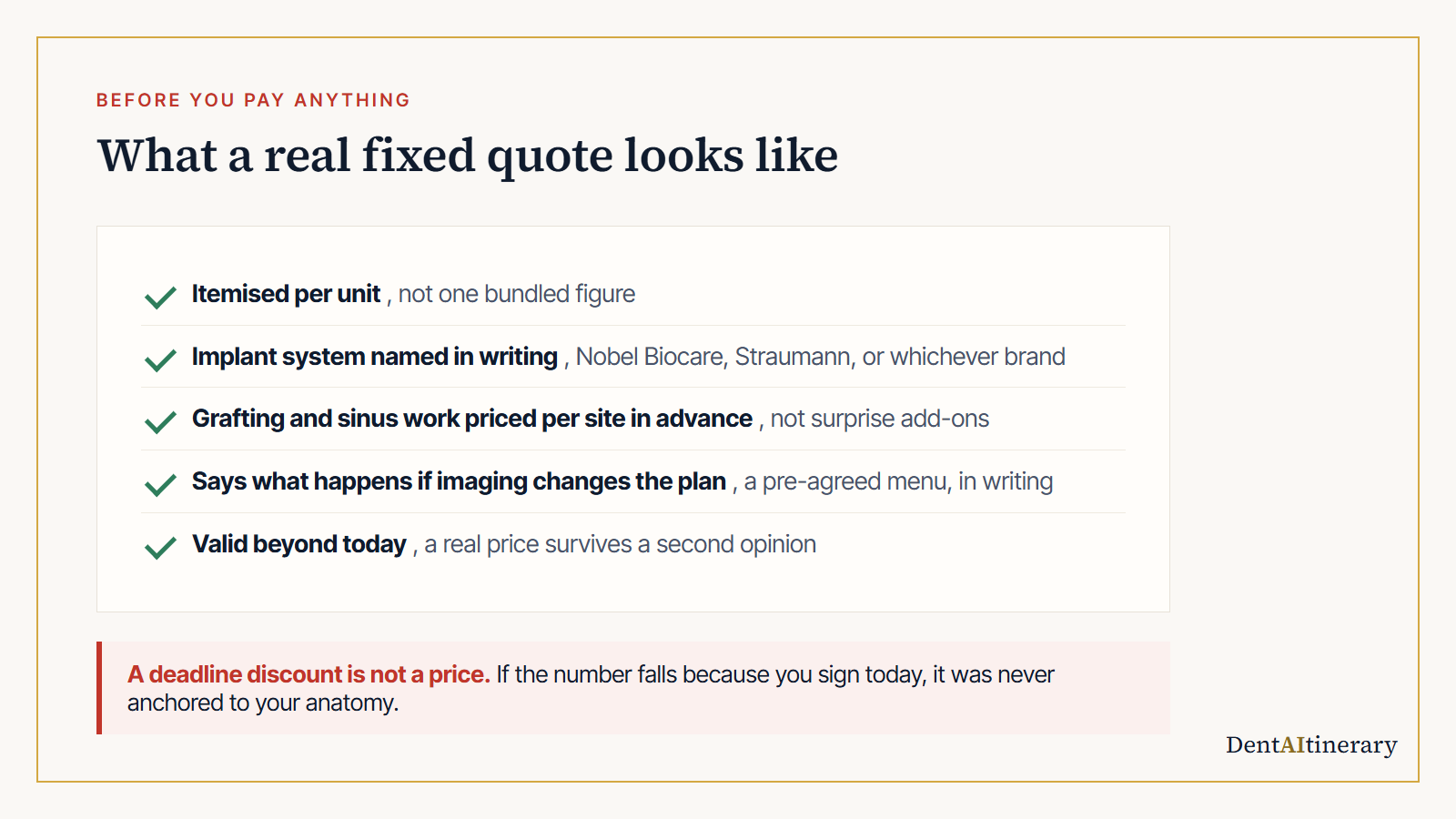
A discount for signing today is not a price. It is a deadline.
If a number can fall by thousands because you commit on the spot, it was never anchored to your anatomy. A clinical quote is anchored to imaging, states its own contingencies, and does not move for calendar reasons. Walk out of any consultation where the price and the pressure arrive together.
Why is a final price without an X-ray a red flag?
Because the number cannot be final. A firm implant price is a claim about your bone, and nobody has seen your bone.
Without imaging, a clinic cannot know how much bone volume you have, where your sinuses sit, how close the nerve canal runs, or which of your remaining teeth are worth saving. Those facts decide whether you need six implants or nine, whether grafting is involved, and whether "save your teeth" is a plan or a slogan. A price given before they are known is a fair place to start. Presented as final, it is a guess dressed as a commitment.
This is not a fringe practice. We have reviewed consultation paperwork for a UK patient quoted for major full-mouth work, extractions and implants in both jaws, where no radiograph of any kind had been taken. The form still carried a firm price, a discount for committing on the day, and the structural work flagged only as an optional add-on.
The pattern to watch is always the same: the less a clinic knows about your anatomy, the more confident the number looks.
What is the difference between an OPG and a CBCT scan?
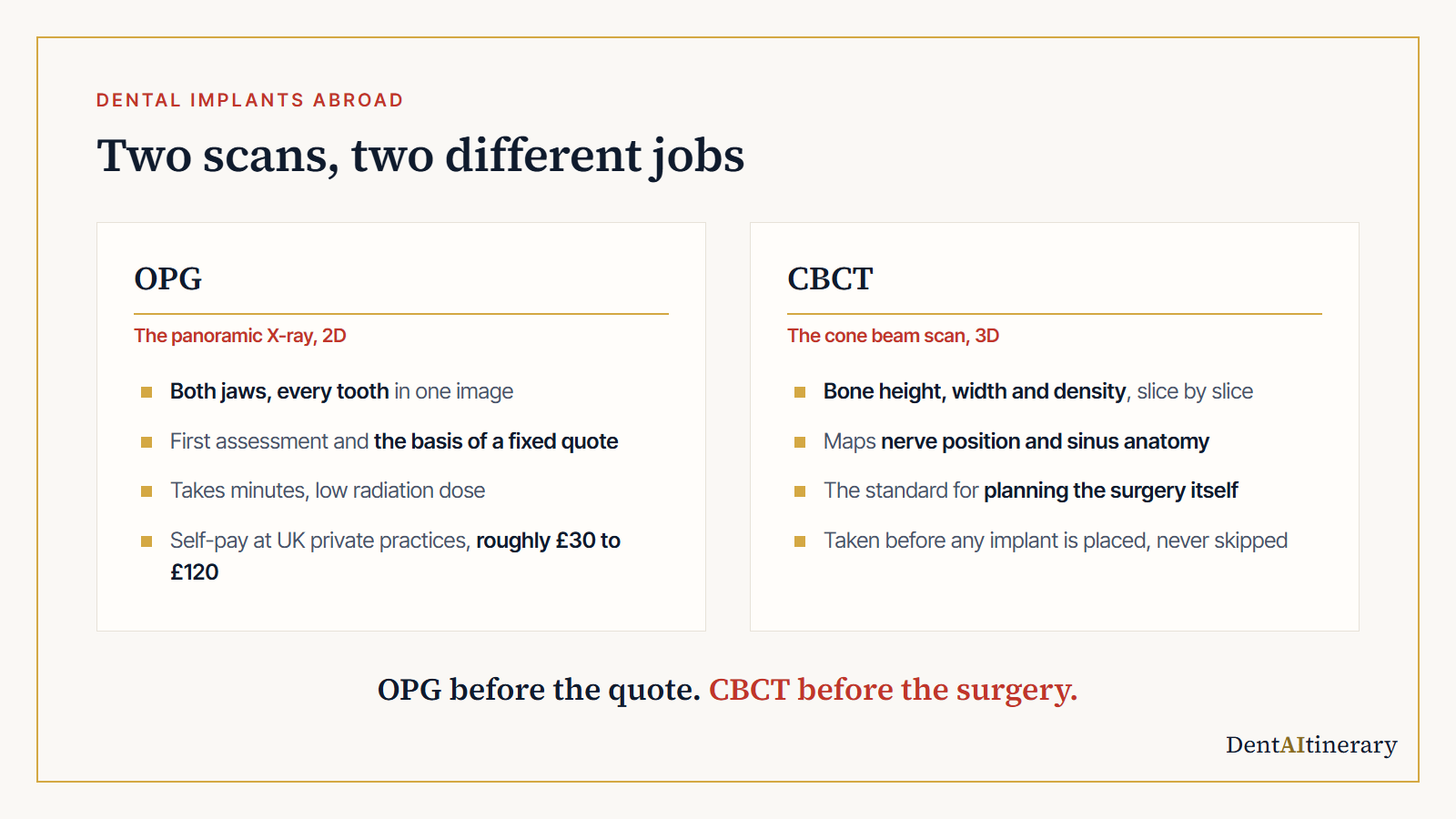
Two kinds of imaging matter for implant work, and they do different jobs.
The order matters as much as the imaging itself: OPG first to establish the plan and the price, CBCT before surgery to confirm both. A clinic that skips the first is quoting blind. A clinic that skips the second is drilling blind.
How much imaging does a real quote need behind it?
Think of it as a ladder. Each rung supports a different level of promise.
A genuinely fixed quote also has recognisable anatomy of its own. It is itemised per unit rather than one bundled figure. It names the implant system in writing, Nobel Biocare or Straumann or whichever brand, because a quote that does not name the system can substitute anything. And it states what happens if imaging changes the picture, so the price moves by a pre-agreed menu or not at all.
How do you get an OPG in the UK?
More easily than most patients expect, and you do not need to go through an NHS referral.
One honest caveat: an OPG taken this year beats medical records from decades ago. Old surgical notes are useful background, but they tell nobody what your bone looks like today. If a clinic asks for your history but not for current imaging, notice which one they treated as optional.
Who pays for the scan?
We do. It is the newest part of how we work, and it follows from everything above.
If we ask for imaging before locking your price, it is not honest to make the imaging your cost. So whatever you pay locally for your OPG or CBCT comes off your package price when you book, up to £150. Send the receipt with the scan and the deduction is applied to your final quote.
This is not a discount, and we would rather you did not read it as one. It is the cost of our own rule sitting where it belongs. The scan is what makes a locked price possible, so the scan is part of the price, and it is our part.
It also means the imaging is never wasted money, whoever you eventually choose. The scan file is yours. If you take it to another provider, you have lost nothing but our company, and if you come to us, it has already paid for itself.
What is the right sequence for dental treatment abroad?
The safe order is a tentative price first, the scan second, the final plan third, and treatment last. In practice:
The sequence to refuse is the one where the scan changes the price and nobody told you how. No list of possible extras agreed in advance, a new number produced in the chair, and a decision expected on the spot. A scan on arrival is fine. A surprise on arrival is not.
This is how every DentAItinerary case runs, and it is written into the quote itself through the Deviation Protocol. See how we vet clinics and lock prices.
Key terms
- OPG (orthopantomogram)
- A panoramic two-dimensional X-ray showing both jaws, all teeth and the overall bone picture in a single image. The standard first assessment for implant planning, available self-pay at most UK private dental practices.
- CBCT (cone beam computed tomography)
- A three-dimensional dental scan showing bone volume and density, nerve position and sinus anatomy. The clinical standard for planning implant surgery, taken before any implant is placed.
- Deviation Protocol
- DentAItinerary's pre-agreed framework for the moment imaging reveals something a quote did not anticipate: transparent pricing from a fixed menu, a decision window away from the clinic, and written consent before any additional work begins.
Common mistakes to avoid
- 1
Paying a deposit with nothing in writing about changes
A deposit on a single bundled number, with no written list of what the scan could add and what each item costs, buys a place in a sales pipeline, not a treatment plan. If the extras are not priced before you pay, they will be priced in the chair after you land.
- 2
Reading a sign-today discount as a saving
A price that drops by thousands because you commit in the room was never anchored to your anatomy. Clinical prices are anchored to imaging. Deadlines are a sales tool, and they work best on people who have not had time to get a second opinion.
- 3
Assuming old records replace a current X-ray
Surgical notes from years ago are context, not diagnostics. Bone changes over time. A clinic that plans around your history instead of your current imaging is planning around the cheaper information.
- 4
Treating add-ons as small print
Sinus lifts and bone grafts marked as optional extras are often predictable from imaging before you travel. If a clinic suspects you need them, they belong in the plan and the price now, not in a surprise conversation after your flights are booked.
Frequently asked questions
Can a dental clinic quote for implants without an X-ray?
+
It can give you a tentative price from photos, and that is useful for planning. It cannot give you a final one. Without at least a current panoramic X-ray, a clinic cannot assess bone volume, sinus position or which teeth are savable. Treat any unscanned price that is presented as firm, or tied to a discount today, as marketing.
What is the difference between an OPG and a CBCT scan?
+
An OPG is a two-dimensional panoramic X-ray of both jaws, used for first assessment and treatment planning. A CBCT is a three-dimensional scan showing bone volume, nerve position and sinus anatomy, used to plan the surgery itself. The standard sequence for implants abroad is OPG before quoting, CBCT before any surgery begins.
How much does an OPG cost in the UK?
+
Typically £30 to £120 self-pay at private dental practices, sometimes including a written report. You do not need an NHS referral. Ask for the digital file afterwards, you are entitled to your own imaging and can send it to any clinic quoting for your case.
Is an OPG enough to plan dental implants?
+
It is enough for a specialist to build a provisional plan and a fixed written quote, provided the quote prices likely contingencies such as grafting per site in advance. It is not enough to operate from. A CBCT scan before surgery is the clinical standard, and established clinics in India take one in-house on arrival day before any work begins.
Is it safe to pay a deposit before the scan?
+
Only if the paperwork already says what happens when the scan is read: which extras are possible, what each one costs, and that you decide with time to think. A deposit changes your psychology, not your anatomy, so once money has moved patients accept revised plans they would have questioned beforehand. Get the terms for changes in writing first.
Does DentAItinerary pay for my X-ray?
+
Yes. Whatever you pay locally for your OPG or CBCT comes off your package price when you book, up to £150. Send the receipt with your scan and the deduction is applied to your final quote. We ask for imaging before locking a price, so the cost of that imaging sits with us, not with you.
About this guide
Written by: DentAItinerary Editorial Team
Reviewed by: DentAItinerary editorial review (see Editorial Policy)
Published: 26 Jul 2026 · Last reviewed:
We follow the DentAItinerary Editorial Policy: every health-related claim is sourced, indicative pricing is clearly labelled, and we do not provide medical advice. See our medical disclaimer.
Get notified of new guides
No spam. One email per new post. Unsubscribe anytime.
Prefer RSS? Subscribe via RSS feed
Ready to see what your trip could cost?
Build a free indicative itinerary in 60 seconds. No sign-up required.
Was this article helpful?
Sources
- General Dental Council: going abroad for dental treatment
- NHS: Going abroad for treatment, treatment-abroad checklist
- NHS hospital patient information on dental implants (Leeds Teaching Hospitals)
- British Dental Association: Dental tourism survey findings
DentAItinerary provides planning information and coordination support, not dental diagnosis or medical advice. Final clinical decisions are made by the treating dental clinic.